Showing posts with label Book Review. Show all posts

Friday, February 4, 2022

The Pivot - By Kurt Campbell - Part C

I now come the final two principles of US policy in Asia as elucidated by Kurt Campbell in his book "The Pivot". I did mention this in Part A of the note that having this 8 point framework is extremely useful as it provides great clarity on understanding America's actions or the lack thereof in the Asian region. So I would thank Kurt once again for distilling these points for us. 

Understaffed & under resourced 

Kurt is unapologetic when he argues that America's engagement with Asia has been episodic which also means resources and staffing has been inadequate. Due to constant surges and retreats towards Asia, the State Department has not been able to develop a large and strong contingent of professionals that understand and appreciate Asia. This has meant that when trouble has arisen in Asia, the US' initial response has been weak and ineffective. 

Numerous examples of this phenomenon have been citied including America's misread of Imperial Japan and following Pearl Harbour a string of defeats ensued for the US. It was only many months into the war that America finally got its act together and was able to defeat Japan. Yet post the war, America could not sustain the peace in Asia. The same outcome transpired in Korea where a short staffed, under equipped America both politically and militarily lost the initial face off with North Korea. That resulted in a surge by America to recover lost ground but the surge was not sustained and America disengaged once again from the region after the ceasefire. The Korean peninsula has remained partitioned till today and is considered one of the global flash points. 

Who lost China? This had far reaching consequences for American diplomacy & the State Department. 

As we saw in the earlier note, after cessation of WW2 hostilities, civil war in China resumed and the communists finally prevailed over the KMT. America's support for the KMT was extremely limited which turned the tide in favour of the communists. Same was the case with South Korea where America's initial support and attention was limited. Further compounding the issue was the Alger Hiss conviction where a US State Department diplomat was found to be a communist spy and was convicted for his activities.  

This gave rise to Senator Joseph McCarthy (JC) and his witch hunt. JC argued that China and Korea were lost because the US State Department had communist spies and sympathisers. Despite showing little or no evidence, JC was able to breathe fire down the US State Department. As a result, a number of professionals were purged that weakened the State Department considerably. 

This had long term impacts when it came to professionals capable of understanding Asia leading to America misreading the situation in Asia more than once. 

This phenomenon has continued. Kurt argues that even today, the number of State Department professionals who have European or Middle Eastern expertise is far greater than those who boast of Asian expertise. This will have far reaching consequences, for an effective pivot by America towards Asia requires a large bench of seasoned professionals & diplomats who have mastered the vast nuances & challenges of Asia. 

Spread & Encouragement of Democracy 

Many countries in Asia have established democratic forms of government due to the backing, assistance, encouragement and even at times a hard push by the US. 

Whilst the Philippines laboured under US rule for a number of years, upon securing independence the country embraced democracy. Democracy was suspended under Marcos but since his departure democratic roots have firmly taken place in the Philippines.

Japan's democracy is a case of direct intervention by America. After Japan's defeat in WW2, the new constitution of Japan was written by America and that required implementation of democratic, liberal values in Japan and curtailment of the role of the Emperor. Japan today is a vibrant and matured democracy and the Emperor is reduced to a symbolic head. 

South Korean democracy came much later than Japan's. Under the strong support of the US, the South Koreans first enhanced and industrialised their economy. However, by the 80s there was a strong push for democracy in South Korea and the US pushed the country to adopt this form of governance. Since then South Korea like Japan is a vibrant democracy. 

Taiwan is not too dissimilar from South Korea. After the KMT decamped to Taiwan post the defeat in the civil war, Taiwan developed economically but politically was not a democracy. Eventually under US encouragement & promotion, democracy took roots in Taiwan as well. Today Taiwan is an engaged democracy and stands as a clear proof that Chinese people and civilisation can be compatible with democratic ideals; something the CCP argues against. 

Looking at the experience of Japan, South Korea and Taiwan, Indonesia too embraced multi party democracy after bouts with the military and dictatorship.

On the other hand, the US has had issues when either democracy has been jeopardised or prevented from flourishing. China of course is the prime example on this issue and the US has been repeatedly arguing and hoping for democracy to flourish on the mainland. The US also sanctioned Burma for its failure to adopt democracy and likewise Fiji was admonished after a military coup. 

There have been times especially during the cold war when the US adopted a more pragmatic approach preferring to ally with single party ruling countries or dictatorships in Asia as long as they were opposed to communism. However, in general the US has been a strong supporter for democratic values and rules based institutions in Asia for a long while. 

Thursday, February 3, 2022

The Pivot by Kurt Campbell - 8 Lessons - Part B

We now come to the next two lessons as enumerated by Kurt Campbell is his book "The Pivot".

Conflict, Military Engagement and Power Projection 

This is one aspect of US' engagement with Asia that many are familiar with but it would be good to lay out some of the key events in this note. Once again Kurt Campbell has done a superb job in bringing these issues out in Chapter 3 of his book "The Pivot" 

The US has been involved in four armed conflicts in Asia. 

1898 & The Philippine War of Independence - 1898 was the year the US defeated the Spanish and gained the territory of Philippines. President McKinley at the time was not even sure where Philippines was on the map. It was something that fell into the US' lap after they defeated the Spanish. The US wanted to civilise, educate and Christianise (recall one of the key pillars from Part A) the locals, however that message did not go down well with the locals. 

War ensured. US despatched troops to the region, suffered casualties (way lesser than the locals) and ultimately held onto the Philippines as a colonial outpost like their European counterparts. Philippines stood in contrast to the US policy of eschewing territorial ambition and favouring trade. There was considerable internal debate in the US when it came to Philippines as a number of prominent Americans disagreed with the Imperialist strategy of the US. However, the Philippines became independent only after WW2 and remained a US colony for years. 

1898 was a key year for the US. It gained access to the Philippines, annexed Hawaii and gained Guam. With these three territories in the bag for the US, the US was able to secure mutually self reinforcing bases from which it could finally project power into the Pacific and beyond. 

Japan & The Road To War - with Theodore Roosevelt now at the helm from 1901, American flexing of power via these naval bases accelerated. The US dispatched troops to mainland China to quell the boxer rebellion and protect its interests on the mainland.

But the greatest friction the US would face would be Japan (note many scholars now look to the issues with Japan as a learning slate for the upcoming issues with China). After Commodore Perry opened Japan up to trade in 1854 (via Naval force), Japan accelearted its development and industrialisation. By the turn of the century Japan was a force to reckon with. In 1905 Japan defeated the Russian navy at the Tsushima Straits and stunned the western world (an Asian country defeated a Western Power). Now Japan was seeking more respect & room to grow and manoeuvre in its 'sphere of influence'. 

Whilst Woodrow Wilson failed in Europe with the League of Nations, Asia was a different story. A number of treaties were signed with the Pacific Powers like Japan & the UK in the 1920s culminating in the Washington System.  These were both diplomatic and military treaties including the infamous 5:5:3 ratio between US, UK and Japan respectively in regard to their naval size and power. With these treaties the US continued to press for the sovereignty of China, prevent colonisation of the mainland and focus on trade and peaceful relations in the Pacific.  

But Japan chafed at this 5:5:3 treaty and whilst it held for a number of years it eventually gave way to Japanese expansion. By the 30s Japan had occupied Manchuria and rejected the naval ratios. An arms race was on its way. But the US was still hesitant in taking severe action against the Japanese. Powers at home favoured a hands off approach. That gave the Japanese further confidence and with that they bombed Shanghai and by 1937 launched a full scale war in China. [Many Asian and Sino observers attribute the start of WW2 not in 1939 but in 1937 itself with the Japanese declaration of war and invasion of China. When I visited a museum in Hong Kong, the tour guide was explicit that whilst world war 2 began in 1939 in Europe, HK, China and Asia were already at war by 1937.] 

The US finally responded. In all too familiar fashion, the US applied sanctions and embargoes on Japan with the aim of starving Japan's military complex. This further hardened the Japanese and public opinion in Japan was inflamed. Yet even now the US was still distracted by events in Europe and did not fully devote its energies to the emerging situation in the Pacific to its detriment. 

A last ditch diplomatic effort between the US and Japan to resolve the situation failed in 1941. Japan felt it was cornered and the only option left was to strike out. That Japan did and the day Dec 7, 1941 "lives in infamy". Pearl Harbour rocked the US, the choice was clear and all out war between Japan and US commenced. The war finally ended in 1945 with the two atomic bombs on Hiroshima and Nagasaki and the unconditional surrender by the Japanese. This was the US' most intensive military engagement in Asia spanning multiple years and multiple countries. 

1950 and the Korean War - The Korean war began shortly after the end of WW2. Dean Acheson gave a speech that defined America's sphere of influence and umbrella of protection and failed to mention South Korea. That was enough for Kim Il-sung, North Korea's Communist leader, to seek the approval of Stalin & Mao to commence the invasion of democratic South Korea. 

In June 1950, Kim's forces crossed the 38 parallel and the Southern forces were over whelmed. The US rallied the UN and Douglas MacArthur made the daring landing at Incheon pushing the Northern forces back to the 38 parallel. MacArthur then convinced Truman to pursue the Northern forces beyond the 38 parallel which was a risky proposition. With Truman's tightly circumscribed approval, the US forces (in contravention of what was agreed with the President) reached all the way to the Yalu River (border of China and North Korea). China & Mao were then drawn into the struggle formally. China committed more than a million troops and the US forces were pushed back to the 38 parallel. [The Korean war museum in Seoul is an excellent place to visit. The museum provides great insights into the war and one can spend a day or two there.]

By 1951, the war was a stalemate. Parties were unwilling to push their forces any further and the situation remains frozen till date. Over 35,000 Americans died in this war and this war was the first war which ended in statement for America in Asia. For US leadership this was a point of intense deliberation and the US resolved never get embroiled in Asia which would lead to the loss of American lives yet the outcome would be a stalemate. 

Vietnam 1961 - The spectre of stalemate loomed significantly in US decision making policy. On the other hand the US also had to take steps to prevent the spread of communism "the domino theory was gaining ground in the US". First China fell to communism, then came the deadlock in Korea with half the country controlled by the communists. 

The next to fall was Indochina. By 1954 the French felt the heat in Indochina and ultimately exited the country ending their Imperial ambitions. Like Korea, the country was divided into a communist North and a democratic South. Like Korea, the North commenced hostilities agains the South with an aim to unify the country under a communist banner. For the US it was a tough call but they decided on limited intervention to prevent the fall of the South.

Limited intervention morphed into full blown intervention. Unlike Korea, Vietnam ended in defeat for the US and more than 60,000 Americans died over a 7 year span. This was a stunning blow to the US which had not experienced defeat before. Vietnam remains a sore point till date in the US. In future conflicts, the outcome and approach of the US in Vietnam was a recurring feature. From the fear of stalemate in Korea to defeat in Vietnam meant rapid adjustments in US policy and decision making.  

The US has also been involved in a more limited fashion across all the three Taiwan Straits issues which flare up from time to time between the PRC and Taiwan. 

Note: Whilst Afghanistan is geographically situated in Asia, it would not fit in the classical definition of Asia for the purposes of this book and hence Kurt has not discussed the Afghan war. 

Episodic Engagement With Asia

The US has failed to have a deep and consistent engagement with Asia. For certain presidents like Theodore Roosevelt, Asia occupied a prime position but that was not the case for all. America's engagement with Asia has risen and then ebbed away leaving a lot of gaps that have created issues of their own. 

Prior to Pearl Harbour the US's response to Japanese aggression was fleeting. The US was not willing to impose sanctions early on and preferred a hands off approach. Contrast that with Europe where FDR was already engaging with the bases for destroyers, lend lease and Atlantic convoy operations well before formal commencement of war with Germany. Not surprisingly the US misread the situation, Pearl Harbour attacks took place and the few months after Pearl Harbour were disastrous for the US. 

Despite a comprehensive win over Imperial Japan, the US was unable to cement long lasting peace in Asia. The US was more focussed on post war European reconstruction efforts, establishment of NATO, the Marshall plan and bringing the western European allies under a common umbrella. 

Who lost China? This is a constant question that plagues America. Post cessation of the war, America was distracted by rebuilding efforts in Europe. With the war in the Pacific won, America de-esclated its forward presence in Asia and China unravelled. America which had ensured Chinese sovereignty for a long time became a passive watcher as the Chinese Civil War escalated. With Japan out of the way, the Communists and the KMT were locked in a death struggle. It is said even Mao was astonished by the lack of US support for the KMT & Chiang Kai-shek. The Communist ultimately prevailed, the KMT decamped to Taiwan and the situation remains the same till date. 

Quoting Eisenhower "the loss of China [was] the greatest diplomatic defeat in this nation's history". 

The loss of China to communism continues to plague America and American policy makers till date. It remains a classic case of "what if instead..."

Losing the peace - The losses did not stop at China. With a fleeting engagement policy and Dean Acheson's message excluding Korea (or ambiguity around Korea) led to the next conflict, The Korean war. Kim Il-sung was emboldened by Dean Acheson's message to exclude Korea from the defence perimeter and his statement of "no person can guarantee these areas against military attack". Plus the US's reluctance with troop deployment in China to support the KMT meant the road to invade South Korea was open. That led to war and ended in a stalemate. Like China, the situation in Korea continues till today. 

Korean war meant a surge for America in Asia but upon cessation of hostilites meant retreat once again. 

The Vietnam war meant another surge once again for America. Given the disastrous outcome of the Vietnam war for the US meant the US further disengaged with Asia. One of the more natural outcomes was the Nixon doctrine where he encouraged Asian nations to take on more responsibility for their own security and push back against communism instead of relying on the US. This is in stark contrast to the US in Europe where the US continued to amplify its support and commitment to combat communism. 

With the detente in place with China by the 70s, the US felt confident to further reduce its gaze on Asia and focus entirely on Europe and combat the Soviet Union. The Soviet threat and mainland Europe was the US preoccupation for a considerable period of time. 

The ending of the cold war in 1991 did not mean the US would refocus its efforts on Asia. The first Gulf war and events in Yugoslavia kept the US preoccupied in other theatres with a consequent continued neglect of Asia. 

Tthe third Taiwan Straits crisis occurring during the Clinton administration and the rise of a nuclear belligerent North Korea should have prompted the US to double down on Asia but it did not. Events of September 11 meant the US would engage in deadly wars in Afghanistan and Iraq. The never ending wars and preoccupation in the Middle East meant a demotion of Asia in the mindspace of America. 

Vacuum does not last long - With the US's focus on other geographies, Asia withered from the agenda. But a vacuum does not last long. This cleared the road for the rise of China. China used this space to develop economically, militarily and politically. It forged trade and ties with countries around the region and used this space to grow and project its own power. 

Today the situation has called for a swift and focussed re-engagement on the part of America. The "Pivot" is supposed to achieve just that. But has too much ground been ceded? Do countries in Asia feel that the US might get distracted once again? Could the US' gaze shift back to Europe with a revanchist Russia? Would there be bi-partisan support for the Pivot to Asia given the Washington grid-lock? 

What about China? Will it make room for the US' re-engagement? Can countries in Asia navigate the trilemma of trade v/s investment v/s military security arrangements? With the US led liberal rules based order survive or will Asia be engulfed in another dispute that could see the emergence of another system?

Many questions that will be answered in this decade!  


Tuesday, February 1, 2022

The Pivot by Kurt M. Campbell - 8 Lessons - Part A (First Four)

Instead of reviewing Kurt Cambell's entire book Pivot (The Future Of American Statecraft in Asia), I have selected the most important and interesting chapter in his book to share his thoughts on eight defining and influential themes that have underscored America's engagement with Asia. 

Kurt Cambell served as Assistant Secretary for East Asian and Pacific Affairs at the Department of State from 2009 to 2013 in the Obama administration. The pivot to Asia was the seminal foreign policy move of the Obama administration which continues till today. The 21 century is clearly the Pacific century and America's engagement with Asia remains the vital piece of architecture for the most important region in the world. 

Whilst the book has many chapters devoted to the Pivot to Asia, Chapter 3 was the most enlightening one for me. Kurt has laid out in an absolutely brilliant manner, the eight themes that underpin America's engagement with Asia. For any watcher of this great game that is unfolding in Asia, understanding and appreciating these eight points are fundamental. I am grateful that Kurt has been able to distill these vital points in a clear and succinct manner and is a testament to his vast experience and knowledge of Asia and diplomacy. 

I will share these eight principles in the order in which they appear in Kurt's book. Without a doubt reading these eight principles gave me an excellent understanding of how America has shaped and will shape its engagement with Asia. These principles are excellent because they provide the bookends to understand America's actions in Asia. What's notable is whilst each principal in isolation might have ebbed and flowed in terms of importance over the past decades, there has been a high degree of consistency across various administrations when it has come to these eight defining features. 

Here are the first four. I hope you enjoy reading these four as much as I did reading them and then distilling them in this note. 

Tyranny of Distance 

For long the US has prided on being a two ocean power namely an Atlantic and Pacific power. However, the depth of its engagement across these two water bodies has been remarkably different. Whist the Atlantic separates the eastern seaboard of the US and continental Europe, the two landmasses are bound by personal, cultural and historic ties. It also helps that geographically Europe is much closer to the US than Asia. Asia is infact twice as far as Europe and even with the comforts of modern travel, the distance between the US and Asia is vast resulting in reduced interactions. The US has attempted to bridge this gap through forward bases like Hawaii & Guam and diplomatic relations with Fiji & Samoa (all landmasses dotting the Pacific ocean), yet the distance remains vast. 

The one US president that made a concerted and powerful effort to bridge the gap and project power and diplomacy across the Pacific was Theodore Roosevelt. In a coordinated attempt he ensured a civilian and military delegation to cross the Pacific in a fleet of ships that made calls at Hawaii, Japan, Philippines, China & Korea over a span of two months. This marked a high point in the US' interest in Asia. It is unlikely that such a large outreach will occur again. Tyranny of distance will remain an inalienable phenomenon of the US' engagement with Asia.  

This gives rise to the second critical issue. 

Stereotypes, Mockery and Underestimation 

Whether its mainstream media, movies, informal conversations or people in positions of high power; there has been a continued stereotyping of Asian people, their abilities, character and threat perceptions. On one hand there has been the "lure of the orient" where Americans have been captivated by Asia as the land of indulgence, elegance and grace. The myth of Asia being exotic, luxurious - a world of its own. This is in stark contrast to Americans perceptions of Europe, which are more grounded in reality, and where there has always been a greater understanding and affinity between the two peoples. 

Perceptions did not stop just at the exotic, but percolated into a thought process that resulted in Asians being branded as weak, fragile and incompetent. That resulted in Americans being caught off guard with Pearl Harbour, but also later again in Korea and Vietnam. The over riding theme being the confidence and capabilities of the American soldiers versus the lack of the same when it came to an Asian army man. That led to many a humbling defeat in wars and battles in the Pacific and Asian mainland and in many cases overwhelming force and swift rearguard action had to take place to stem initial losses. 

Incredibly the perception of Asians on the American mainland has been around threat and menace. From Chinese labourers being the cause of depressed wages in the 1850s, to bans on Chinese immigration to the internment of Japanese origin but American citizens during WW2. Whilst 120,000 odd Japanese origin American citizens were rounded up being perceived as a threat to the war effort, more than 10 million German American citizens did not face the same issues. Kurt quotes Time & Life Publisher Henry Luce "Americans had to learn to hate the Germans, but hating Japs comes natural". Post war attitudes changed towards the Japanese but they resurfaced in the 80s as Japan rose as an economic super power with a perceived threat to challenge American economic dominance. 

Stereotypical casting of Asians and Asian societies still remains in America and can play a vital role in how Americans and America perceives Asia.   

Trade - Cornerstone of American interest in Asia 

Trade with Asia has been explored right from the founding days of America. The Empress of China left NYC as early as 1784 to commence trade with China. [http://www.wiu.edu/cas/history/wihr/pdfs/wihr-empress-of-china.pdf] and returned back after 15 long months. Whilst America was keen to trade, Asia was reluctant to reciprocate trade outreaches with America and the Europeans; preferring to remain insular and keeping the 'barbarians' away.

In 1833 America was able to persuade the Kingdom of Thailand to commence trading starting a critical process for Asia but made little headway in China, the prime target. Unlike America, Britain though had little patience. As Britain's trade deficit ballooned with China, Britain attempted to offset it with opium imports into China which was fiercely resisted by the Chinese. By the mid 1800s, trade gave way to conflict and China faced the first of the opium wars (1st Opium war ended 1842). With heavy defeats, China opened up to trade, signing what are now known as the the unequal treaties (also commencing the century of humiliation). This meant that China had to open up its ports to foreign powers, notably Britain. 

America preferred trade to war with the Chinese and Treaty of Wanghia (1844) gave the US equal treatment on par with the British when it came to Chinese trade. [https://history.state.gov/milestones/1830-1860/china-1]. With this treaty, trade grew and with that America's interest to protect its trade flow with China. The US pushed to ensure China's sovereignty with a view to ensure continued trade flows between the US and China and prevent European colonisation of China. The flag was following the trade here although America's principal focus being on trade rather than acquisition of Chinese territory. 

But trade followed the flag in the case of Japan in 1854. The exploits of Commodore Perry & the US Navy's show of force in Tokyo bay culminated in the treaty of Kanagawa resulting in the opening up of Japan to trade. Yet another Asian country was now open to trade with America and the Europeans. Japan's trajectory was in stark contrast to the Chinese who continued to remain insular and unaware of the changes surrounding them. [https://www.history.com/this-day-in-history/treaty-of-kanagawa-signed-with-japan]

1899 was a pivotal year with the establishment of the Open Door Notes (modern day precursor to the WTO). The US got the other major powers of the day - UK, France, Russia, Germany and Japan to agree to free & open trading, equal trade status for all powers and to eschew territorial ambitions in China. The US wanted via Open Door to promote free trade, lower tariffs and avoid territorial footprint in China. The US wanted equality of treatment when it came to trade & China and likewise further open China to free trade and commerce. Ironically this is also the time the US was implementing immigration bans on the Chinese into America [https://history.state.gov/milestones/1899-1913/hay-and-china]. The was America's alternative proposition to "European Colonialism". 

When war broke out between Russia and Japan, America even became a peace broker and put an end to hostilities in the Western Pacific. The chief aim of America again being preserving trade in the region, something a conflict between two major powers (Russia and Japan) would heavily disrupt. For this, Theodore Roosevelt was awarded the Nobel Peace Prize in 1906. 

The US continued to ensure that trade was prioritised over all other factors in Asia. Trade with Asia was hugely beneficial to the US and the US with diplomatic and military might continued to ensure this would be the case. This was America's policy even as WW1 broke out in Europe. 

Post WW1, there was no change in America's policy towards Asia. However, as America's might grew so did its ability to establish the American order in Asia which prioritised trade. 

The early 1920s saw a series of trade, geopolitical and military agreements being signed known as the "Washington System". The US got all the major European powers & Japan to execute what is known as the Nine Power Treaty (US, Japan, Russia, Britain, France, Italy, Belgium, Netherlands and Portugal). This treaty ensured and reaffirmed the sovereignty of China, equal trade opportunity for all the nine countries and promote trade over imperial conquest. What I did observe is that whilst trade with China and Asia was central to this treaty there was no Chinese presence or involvement! 

Unlike Europe, the US was able to secure a treaty in Asia and keep the peace for a few years. Till of course WW2, by which time the entire continent of Asia was engulfed in total & absolute war ending with the unconditional surrender of Japan in 1945. 

Post WW2, the US was integral to the efforts to reconstruct Japan from the ashes. Japan grew spectacularly in the years after WW2 eschewing military ambition for trade, commerce, and technology whilst the US provided the security umbrella. Japan's model became a template for South Korea, HK, Singapore, Taiwan, Malaysia and Thailand to follow. A model that focusses on trade, goods, manufacturing, open access, competitive wages, lower trade barriers and minimal military conflict. 

Trade therefore has been emblematic of America's engagement with Asia right from the commencement of the Republic. Whilst America has periodically been dragged into many conflicts in Asia, it has consistently promoted trade in the region. Trade, therefore, becomes critical to any US policy and ambition in the Asia Pacific region.  

Religion and Christianity 

American missionaries saw the vast and untapped potential of Asia's large and burgeoning population as an extraordinary opportunity to spread their faith. With faith having a strong anchor back home in the US, American missionaries set out very early on to spread the faith to Asia. In this regard faith and trade moved alongside although it may be argued that they were not inter-dependent. 

Kurt contrasts the attitudes of America and Britain in this regard and emphasises that America pushed heavily on the spread of the faith unlike Britain. The British East India Company for instance never put faith on top of its agenda when it came to Asia. From Kurt's perspective spread of education was fundamental to the missionaries and an anathema to the East India Company. 

With strict controls on the interactions between Chinese and foreigners in place, it was the missionaries who early on devised creative means to engage with the locals and were the first to learn the Chinese language - through craft and ingenuity. 

The missionaries failed in their efforts to en-masse convert the million of Asians but their impact is felt across countries especially in the field of education and health. 

Kurt highlights the work of two prominent missionaries. (a) John Scudder Sr and his family. The family's work was focussed on India and the Christian Medical College and Hospital at Vellore, India is an example of the work. (b) John Leighton Stuart in China - his work around Yenching University in China and establishing close links between Yenching, Harvard and Princeton. Yenching was closed by Mao but Peking and Tsinghua university have adopted many of Yenching's departments. 

Kurt also highlights the closeness of the missionaries with the US government. John Leighton Stuart became US ambassador to China. John Paton Davies & John Service, both missionaries led the first efforts to engage with Mao and Communist Party. 

The Methodist and Catholic churches continue to focus their efforts on Asia. As religion declines in Europe, the church sees Asia as a 'pivotal' market to further its faith. 

Asia's relationship with the church and missionaries will continue to remain frosty or viewed with suspicion. On the other hand, whilst the American state does not formally and actively propagate religion, missionary activity and their protection will not be entirely abdicated. 

Sunday, January 30, 2022

The Rare Metals War - Guillaume Pitron

The Rare Metals War is a recently published book in 2020 by investigative journalist and author Guillaume Pitron. The book revolves around Rare Earth Metals (which we shall discuss in a bit below), the darker side of clean energy and digital technologies and new geo-politcal issues around concentration risk and supply chains. According to Guillaume, rare earth metals sit at the very cross-roads of clean energy, technology and the upcoming China v/s the Western World geopolitical fight. 

We should start by examining what are rare earths / rare metals (RE). RE's are a group of metals that are not as rare as the word suggests. In total RE metals are seventeen in number also called Lanthanides.They are found in moderate quantities but largely in association with abundant minerals like iron and are hard to extract and refine. There are very few standalone RE mines like copper or iron ore mines for instance. RE are soft, malleable, solid, iron/silver grey in colour and highly reactive at high temperatures. RE uses are varied and find application in super alloys, catalysts, industrial applications, batteries but most importantly in high performance magnets in the technology space.

As the world pushes to decarbonise, there is a greater emphasis on electrification. The world is pushing to replace hydrocarbon combustion with electricity. Magnets therefore find massive applications ranging from motors used in Electric Vehicles (EV)s, wind turbines and in smart devices like handphones. 

The world is on the cusp of another industrial revolution. As the book argues, the first great shift occured with the use of coal by England resulting in the steam engine. This enabled the prime mover to move away from animals and humans to a natural resource (coal) and boost productivity. Coal was followed by oil & natural gas which further enhanced productivity and radically upended our lives. However, given the environmental impact of hydrocarbons, the world is once again moving to another revolution which is the confluence of clean energy and high technology. 

The country that dominates the production, extraction, refining and consumption of RE is not England or Europe or the US but is China. China has achieved scale in RE mining and production. Production of RE is environmentally challenging as it involves crushing a large amount of source rock, then refining the same using acids and purifying using copious amounts of water. Some RE mines have radioactive Thorium and Uranium as by-products making disposal tricky for the mine owners. Despite the challenges of extracting RE, their use and demand continues to grow and China exhibits a vice like grip over them. 

The Dark Side of Green & Digital Technologies

Chapter 2 is a critical chapter in this book and a must read. This chapter highlights a key learning to consider whilst evaluating current v/s future technologies whether its clean power generation, smart grids or EVs. 

Taking EVs as an example, it is unarguable that EVs are way cleaner than gasoline cars due to the absence of hydrocarbon combustion. However, it is important to peel away the layers to get a holistic perspective. EVs are driven by batteries that require cobalt, copper, lithium, aluminium, nickel, manganese, graphite etc. They also have an electrical motor that needs copper windings and RE magnets. As a consequence, an EV requires a lot more metal than an gasoline car although over a lifetime it still beats the gasoline car due to the absence of hydrocarbon combustion. 

The key takeaways from this chapter would therefore be the importance of end to end analysis of new age products. It is not sufficient to consider the emissions impact from the point of purchase only but to consider the entire product lifecycle from manufacture to use and also disposal. 

Likewise, a lot of renewable power generation like wind turbines and solar panels need significant amount of minerals plus steel and concrete as compared to the more traditional generation sources like natural gas fired plants. What therefore should be avoided is replacing emissions in urban settings and increasing emissions and ecological issues in key mining locations. Finally the impact of recycling should be considered in sufficient detail. Whilst recycling is fundamental and efforts to enhance recycling rates are to be lauded, recycling can become energy intensive especially when it comes to trace elements like RE. 

China and RE

China was not the leader in RE. America, Australia, the EU and Japan were leaders in the extraction, refining and consumption of RE for a long while (China's market share then was below 10%). But by the 80s and definitely by the 90s the winds of industrialisation began to change and China gained ascendency. Guillaume elaborates why this happened and a number of factors come into play to explain this.

Firstly, environmental norms in the West & Japan started to tighten up considerably. Mountain Pass, the then largest RE mine in the world and located in the US faced considerable headwinds from environmental issues. This impacted profitability and the operations of the mine.

On the other hand, China in 80s and 90s was keen to rapidly industrialise. China made forays into RE mining, building scale and turning a blind eye to the environmental aspects of RE mining. As a result RE prices in China fell and ex China mining of RE shuttered including in the US, France and Australia. 

This was actually welcomed by the West at that time who felt that it was a masterstroke to 'export' polluting industries to the global South like China and maintain a clean environment at home. 

With the advent of globalisations, supply chains went global. End consumers cared little where the products originated from and where basic heavy industries were located. There was greater focus on lean supply chains and efficiency from a cost perspective rather than the origin of goods or resilience of supply chains. All this seemed like a win win situation which could only get better. 

However, things turned out a bit differently!

From Dominance To Power Projection 

After consolidating production, enhancing supply chains and capturing more of the value add, China felt confident to assert its domination over key raw materials. First it established export quotas that reduced RE exports year on year thus curbing non Chinese consumtpion and encouraging consumption at home. 

Then came the infamous incident with RE and Japan in 2010 that put the world on notice. Because of a dispute with Japan linked to fishing and ownership of the Senkaku islands in 2010, China 'cut off' RE deliveries to Japan. Japan which was heavily dependent on RE imports from China was hugely impacted. RE prices sky rocketed in the global market. The US, EU and Japan filed WTO complaints against China. Years later the embargo by the Chinese was termed illegal but the damage had been done. With a RE market share of more than 90%, China had an oversized hand to play when it came to RE. 

The US, EU and Japan commissioned detailed studies on their import vulnerabilities with respect to critical minerals. All these countries concluded that China plays a vital role in the supply chains in many minerals (not just RE) which is a cause of deep concern for all of them. Since the 2010, various attempts have been made to establish RE mining and refining outside of China but it has been met with muted success. The ability to decouple and establish a supply chain for RE independent of China has not yet fully materialised. 

As of today whilst RE mining has restarted in the US and Australia, China still has more than 60% market share for RE mining. More impressively its market share for refining and processing RE stands at around 85%! This is a decade after the west and Japan decided that supply chains for RE were overly concentrated in China. 

Not Pausing At Mining & Refining

A defining feature of China's dominance in RE has been its ability to develop and master the world beyond just RE mining and refining. As the book demonstrates, export bans and quotas have been adopted by many countries around the world. Yet few countries, if any, have developed expertise across the value chain for the respective mineral. 

China on the other hand has developed the same and the world of high performance magnets brings us to the next pivotal moment in China's quest for domination. Whilst the west was focussed on reducing polluting industries at home and driving down costs, China was focussed on upping the ante in high tech manufacturing. 

The origins of China's march towards manufacturing dominance and technological upgrades is captured in their five year planning policy documents. These planning documents set the targets and the stage which in turn provides the impetus for Chinese companies, including the SOEs, to set their own goals and aspirations. Many of these policy documents have focussed on the importance of RE mining but also the need to go beyond just mining and refining RE. 

The Magnequench saga best exemplifies how this approach unfolds on the ground with the Chinese making a concerted effort to secure patents, know how and knowledge in the high tech magnet world. RE play a pivotal role in the manufacture of high tech magnets which in turn drives the digital and new energy world. 

In 1995, the Chinese state in conjunction with Chinese SOEs made a bid for Magnequench, a leading cutting edge magnet manufacturer, with sole aim to understand the technology behind high tech magnets. High tech magnets are fundamental to the digital world and the new energy space and mastering high tech magnets allows a country to dominate these key sectors. This is exactly what happened. Five years after securing the approval (heavily contested acquisition processes) to acquire the company, Magnequench's operations were terminated in the US and the factories were entirely relocated to China.

Fast forward a decade or so, the leading manufacturer and exporter of high tech magnets is no longer the US or its erstwhile competitor Japan but is China. China does not lead, it dominates! This domination is so  impressive that the US F-35 fighter jet program had to seek exemptions to buy and use Chinese magnets as no other alternative was possible! 

Looking Beyond RE

Whilst this book is centred around RE, the lessons and observations can be extended to a number of other minerals and the manufacturing sector as a whole. The US and Western countries have essentially hollowed out their manufacturing and mining capabilities. With a confident but erroneous belief that one can sustain purely on innovation, the US and the West have surrendered large swathes of territory to China. 

China on the other hand is relentless. It has exploited this chasm to perfection. Commencing from the position of a benign, low cost responsible producer of goods for the world, it has steadily moved up the ranks of research, innovation and quality whilst continuing to build scale across industries. This has now put China as a clear threat to the US domination of future technologies. Using its vast manufacturing base, trained staff, state support, immense funding of R&D and a determined will, China has put the US and the world at large on notice. 

With Make in China 2025 personifying the grand ambitions of the Middle Kingdom, the country aims to become a global manufacturing, cyber and science and technology superpower. I don't think any further explanation is needed to this statement. The target date is 2049 - a 100 years since the establishment of the People's Republic of China. 

Conclusions 

The book makes for interesting reading as it focusses on two key issues namely the metal and mineral intensity of new age energy solutions and the dominance of China across the very vital supply chains that will enable this transition. More importantly, the lessons from the evolution of the RE industry can be applied to a number of sectors and I am confident the conclusions will largely be the same. 

The greater questions are will China achieve its vision as set out in Make in China 2025? Has COVID changed the dynamic in favour or against China? What steps can the US and the West take to counter China? Will the great decoupling take place or will it be stymied by factors of cost, inertia and efficiency. Will the US led liberal rules based order hold in the coming decades or will we witness some cataclysmic shifts in this regard? Who will lead the next digital, energy and industrial revolution? 

Despite all the uncertainty and the high stakes involved, one thing is certain. Understanding the US and China and their relationship will be fundamental in the coming decade. 

https://www.amazon.com/Rare-Metals-War-Digital-Technologies/dp/1950354318

The Rare Metals War: the dark side of clean energy and digital technologies  by Guillame Pitron

My Book Review Event 

Brow Sing - a book and knowledge enthusiast club asked me to review this book in Jan 2022. Below are the slides that formed part of this book review. 

The book review had two critical themes.

A. The importance of metals and minerals in energy transition. Whilst the above book is focussed on rare earths, I expanded the discussion for the audience to cover other metals such as copper, zinc, lithium, cobalt amongst others.

B. The dominance of China in supply chains. China has assumed a very dominant position across the entire value chain of the low carbon industry. Beyond just mining RE, China has focussed on developing scale and market shares across all key minerals needed for energy transition. In addition, the country has build up capabilities in EV and battery manufacturing and wind turbines and solar panels. What is the impact of the same and how will it affect the rest of the world as tensions rise but the pivot to low carbon accelerates? These were questions, we attempted to answer. 

Attached are the slides below.

Link to slide deck


Monday, January 10, 2022

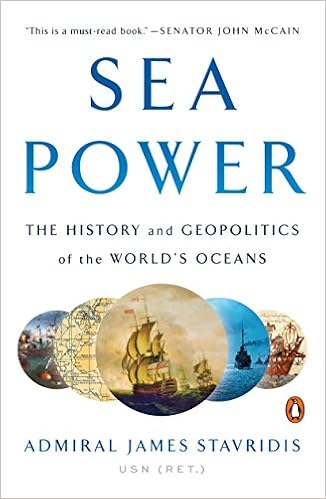
Sea Power by Admiral James Stavridis

Sea Power, a book written by Admiral James Stavridis is about the history and geopolitics of the world's oceans & seas. Admiral Stavridis is a retired four star admiral of the US Navy and the first Admiral appointed as the supreme allied commander of NATO. In a multi decade career with the US Navy he has commanded battleships and a carrier strike force around the world. He also holds a PhD in International Relations, is currently Dean of the Fletcher School of Law and Diplomacy at Tuff's University and a Managing Director at the global private equity firm, Carlyle. 

Admiral Stavridis is a prolific writer, has written many books besides this one and his TED talks attract a large viewership. To get more information about him, you can visit his website https://admiralstav.com/

When a four star admiral of the US Navy who was also the supreme allied commander of NATO writes a book on Sea Power, it becomes a must read. Sea Power shares incredible details about all of the Earth's oceans. The unique perspective that Admiral Stavridis can bring is he has seen all these oceans at close quarters having sailed across them as part of the US Navy. 

The book commences with the largest one, the Pacific followed by the Atlantic. These are the two oceans of paramount importance for the US Navy but also for the world at large. The next stop is the Indian Ocean which is smaller than the first two but rapidly gaining in importance followed by the Mediterranean Sea, the South China Sea, The Caribbean and The Arctic Ocean. 

Each of the chapters share the maritime history of the ocean body from antiquity till the commencement of the 20th century. The admiral goes into interesting details around naval battles and waterborne trade to give the reader a good insight into each of these key water bodies. He then goes into a bit more detail around the recent past including key naval battles from WWI, WWII and those that have occured in the past few decades including ones where he has had first hand involvement. 

These chapters give the reader an excellent perspective around the dynamics of each of these oceans and seas. One can clearly walk away appreciating the similarities, differences and challenges after reading them. My personal favourite is the one on the Arctic, a fascinating water body that is going to become an extremely dynamic geography in the next decade or so. The Arctic is where the US and NATO will face off with Russia, climate change will play a pivotal role in defining the geography and the ocean could become the new frontier for mining and exploration of natural resources and the backbone of world trade. 

The second last chapter talks about three vital aspects of oceans which we might not consider as very important but the Admiral explains exactly why we are wrong in our thinking. The first issue is the deadly menace of piracy, then is the intensive and unregulated fishing industry and finally the environmental degradation of the oceans. All these three topics are extremely critical that impact each of us and getting the insight via the book was eye opening. With regard to piracy, I should add, the Admiral was personally responsible for organising a massive task force involving NATO plus the likes of Russia, China, India, Pakistan & Iran to combat it. Hence, the insights just on this topic alone are incredible given his first hand experiences. 

In the final chapter, Admiral Stavridis addresses the naval strategies and challenges for the US, NATO and its allies. How the grand geopolitical maps & plans to control the world's oceans will pan out over the next few decades. How players like China and Russia could pose threats to the world order and how naval tactics including undersea warfare could evolve. He shares valuable insights into the doctrines of Alfred Mahan (father of US Naval strategy) but then provides additional perspective into how the doctrines of Mahan need to adapt to the modern world and rise up to new challenges.

Sea Power is an excellent book written by an extremely knowledgeable author who has had first hand insights into the world of seas and oceans. We don't seem to fully fathom the importance of oceans hence this book is a great read to reinforce that we are more water than land and understanding our oceans and the power that comes from them is vitally important to our present and fundamental to our future.


https://www.amazon.sg/Sea-Power-History-Geopolitics-Worlds/dp/0735220611/ref=asc_df_0735220611/?tag=googleshoppin-22&linkCode=df0&hvadid=404127552673&hvpos=&hvnetw=g&hvrand=16979480338693770386&hvpone=&hvptwo=&hvqmt=&hvdev=c&hvdvcmdl=&hvlocint=&hvlocphy=9062546&hvtargid=pla-525156634451&psc=1

Saturday, December 11, 2021

China's Leaders From Mao To Now - David Shambaugh

China's Leaders from Mao to Now is a book written by David Shambaugh, a political strategist, professor and a long time contemporary China expert. He is a professor at George Washington University in the US and focusses on Chinese politics, political systems, modern China, China foreign relations, the Chinese security apparatus and Asian International Relations. He has written extensively on China & the Chinese Communist Party, has lived in China, studied in China and has observed China very closely for decades. 

I have read another book written by David - Where Great Powers Meet - a book about the countries of South East Asia and they being at the epicentre of US / China conflicts across investment, trade and diplomacy. Both these books are written with a lot of data and information, akin to a serious text book but aimed at the average reader rather than a political affairs journal. This makes it an easy read yet provides the reader with considerable perspective on the topics. My understanding of China's leadership has been greatly amplified after reading this book.

For any country leaders matter. Leaders are there to project the image of the country, leaders get associated with the history and legacy of the country, they formulate the present and construct the future. Understanding leaders is part of understanding a country. In China's context that becomes significantly more important. Unlike countries like the US, where leaders have to contend with institutions, opposition parties, a vocal electorate and an intrusive press, in China leadership plays an extremely pivotal & influential role. In a centralised, command and control apparatus state with limited checks and balances, the leader of the state plays an outsized role that shapes generations.  

This book attempts to profile, evaluate, compare and contrast the five key paramount leaders of China from Mao to Xi and present the reader with a deep analysis of their leadership styles. After reading this book, I was able to understand in significant detail how the leadership in China has evolved and how each leader has differed resulting in major inter generational shifts. As I mentioned earlier, in a strict command and control state like China, what the leader does, his (there has been no her so far) style, his background, his vision and approach and ascent to power matter immensely. China is a relatively opaque country with few institutions and data dissemination is strictly controlled, hence understanding the CCP and the paramount leader is vital in understanding China. 

In my review, I shall summarise in just a few lines what I learnt about each leader from Mao to Hu Jintao. I do this for a couple of reasons. For leaders like Mao and Deng, many books have been written on these two personalities given the transformational impact they had on the country. I would suggest people to read them to get a better understanding of the personalities should they want a very detailed understanding. Secondly, the leadership impact from Mao to Hu Jintao is slowly but surely fading away hence a more detailed analysis of Xi's leadership is merited. 

With that in mind, this is what the book says about these five paramount leaders of modern China. Note these are all David's reflections and not mine. Also this being a succinct book review, it cannot capture all the points, details and nuances that David covers in his book.  

Mao Zedong : the author's last sentence in the book about Mao best summarises Mao's impact on the country. According to David "Mao's greatest accomplishment was to unify the nation - but his greatest failure was to tear it apart" Mao led China from the founding of the PRC on October 1, 1949 till his death in 1976 and had an oversized impact on the country. He favoured a strong personality cult and devotion approach, remain in a constant state of revolution, was enthusiastic in exporting his revolution to other countries, deeply disliked institutions & intellectuals. Hence Mao's China was noted for a number of mass people movement events like the Great Leap Forward, The Cultural Revolution, Hundred Flowers Campaign and the Anti Rightist Campaign. For Mao, revolution to gain power was not sufficient, there had to be constant revolution thereafter to ensure ultimate goals are achieved even if the goals themselves could be unclear. 

The effect of these campaigns was disastrous, millions lost their lives and the country remained in a constant state of flux, anxiety, confusion and insecurity. There were repeated purges of leadership across the CCP and no one felt secure outside and within the CCP; the only constant throughout this long period was the presence of Zhou Enlai. 

Mao was firmly entrenched in Chinese foreign policy and played a key role in building a strong relationship with the Soviets but then oversaw the complete cratering of this relationship and the two nuclear nations were on the brink of war by 1969. Mao played a key role in the Korean War. From a foreign policy perspective, Mao is best remembered for his historic meeting with Richard Nixon in 1972, an event that might be counted as one of the most significant events of the entire 20th century.  

Deng Xiaoping : Deng served as China's paramount leader from 1978 (his impact preceded his formal title) till 1989 and is widely recognised as the architect of the economic rise of China. Unlike Mao, Deng was pragmatic, an institutions man,  consensus builder, welcoming of divergent opinions and seeker of expertise. Unlike Mao, Deng was not entirely distrustful of the West. Deng also recognised China's frailties as it emerged from the years under Mao. 

Deng inculcated changes to the PLA after it failed to achieve its objectives in the 79 Sino Vietnam war. Deng also led the structural reforms of the economy and the establishment of special export zones in the coastal regions of China. Deng worked hard to strengthen the CCP apparatus and re-build an institution to govern which is in contrast to Mao who decimated the party. Deng widely travelled outside of China unlike Mao (who only left China twice to visit the Soviet Union) and embraced western economic principles. Deng is famous for his visits to Singapore, Japan & the US and his astuteness in recognising how countries like Singapore and Japan had leap frogged whilst China was languishing linked to an outdated ideology. Deng preferred to delegate unlike Mao who was totalitarian and utterly centrist in his approach. 

However, it does not mean Deng the economic reformer was the political reformer. Deng was ultimately responsible for brutally quashing the Tiananmen Square protests in 1989 that resulted in the PLA taking aggressive actions against the protestors that led to thousands of civilian deaths. Ultimately, Deng is remembered as the man that picked up the post Mao pieces of China, applied pragmatic and rational thinking, readily accepted the weaknesses in China, unleashed economic reforms, and carved the path for the rise of contemporary China.    

Jiang Zemin : The unnatural candidate who was thrust into the paramount leader position after Deng was Jiang Zemin. Before Jiang assumed his role and position, very few in China knew of him and fewer expected him to helm the ship. Upon his appointment, many expected Jiang Zemin to be a 'flower pot' and last a few years before a big shake up would produce a new paramount leader. Jiang defied these expectations, lasted two full terms and his power and influence was felt even after he has left his formal positions. Jiang and his chosen ones continued to impact Hu Jintao's first term in office. Jiang was the first of the technocrat trained leader for China, having studied electrical engineering and worked in Soviet Russia which marked a change from Mao's and Deng's backgrounds. 

Jiang's foremost challenge was bringing China back into the international fold following sanctions and widespread condemnation post the Tiananmen Square tragedy, a task he managed adroitly. Jiang Zemin is also famous for presiding over the peaceful transition and hand over of Hong Kong from the UK to China after he clearly indicated that China would not extend Britain's lease over the island colony. Jiang is also instrumental for the development of the 'one country two systems' concept that would characterise Hong Kong's handover.  Jiang turbo charged the economy although many would accuse the Jiang Zemin period of high but unequal growth that favoured the coastal regions (Shanghai especially) and highly environmentally degrading. However, looking at Chinese GDP growth during his tenor, the verdict is clear; a high of 14% (1992) and on average remained above c. 8% level for his entire term is incredible. Jiang Zemin definitely scored high when it came to steering the Chinese economy. 

As a personality, Jiang was unlike Mao and Deng and unlike any other Chinese leader. He was outgoing, confident, went off script at times, gregarious and keen to engage. Most importantly, Jiang's term as paramount leader coincided with momentous events in Europe including the fall of the Berlin Wall, dismantling of communist states like Poland, termination of the Warsaw Pact and the ultimate - dissolution of the Soviet Union in 1991. 

For China and the CCP this was one frightening event and many political watchers would commence writing the obituary of the CCP as well. After all, the fountainhead of inspiration for the CCP was the Soviet Union and here in 1991 the almighty Soviet Union itself collapsed. But the events in Europe did not result in the same outcomes in China and under Jiang Zemin the CCP did not unravel and the political system remained unchanged. From this point on, all political leaders in China will continue to evaluate and analyse the fall of communism in the West and seek their own independent assessments to prevent the same from impacting the CCP. From a foreign policy perspective, Jiang Zemin focussed his efforts on the larger powers notably the US, Russia and the EU during his term in office.

Hu Jintao : Hu Jintao assumed office in 2002 and ran for two full terms. Unlike Jiang Zemin who was catapulted into the top job as an unknown, Hu was anointed as a possible fourth generation leader by Deng himself. According to David, Hu had a decade to prepare for the job, a stark contrast to his predecessor but did not use that decade wisely and when he did secure the top job as paramount leader, he lacked a wide base and appeal. Hu Jintao's personality is also a direct contrast to Jiang Zemin and is considerably more measured, sterile, entirely scripted and never veered off the agreed path. Hu Jintao's and Wen Jiabao's (State Council Premier) ten years in power are widely considered by the Chinese as 'ten lost years'.  

Economically, Hu Jintao adjusted his predecessor's approach to the economy. Growth at all costs was modified to have a more inclusive growth model. Jiang Zemin had favoured coastal development and Shanghai based businesses. Hu Jintao started to focus on the internal provinces and tried to adjust the gap between the coast and the interiors. He also focussed on the environmental aspect of growth which was neglected under Jiang. Annual average growth rate under Hu Jintao was a staggering 10.5%. 

Hu Jintao continued to try to reform and liberalise the party and the country. However, he had limited success and especially by his second term, hardliners had a more dominant position than him in decision making. Hu Jintao also presided over three key events for China namely the Beijing Olympics, the Shanghai World Expo and the 60th anniversary of the PRC. Again Hu Jintao demonstrated a steady hand across all three events. Hu Jintao also made a major foreign policy pivot by engaging the wider international community. Whilst Jiang had largely focussed on the leading western nations, Hu Jintao began to engage the global south. China's outreach to African nations and other developing nations occured under Hu Jintao's tenor. Hu Jintao also was the first to stress the importance of 'soft power' when it came to global outreach. Relations with the US and Taiwan were also positive and according to David best across decades. 

David does argue, Hu Jintao did not fully establish his own personal mark across his two terms. The initial portion of his term was partly influenced by Jiang Zemin who continued to maintain his presence despite his term having ended. The latter part of Hu Jintao's term was impacted by the rise of conservatives namely Bo Xilai and Xi Jinping. Unsurprisingly, 2009-10 is marked as a pivotal year for China - "the year of assertiveness". This marks the time when China's relationship with its neighbours and the wider international community began to take more antagonistic proportions and change course. 

David feels that whilst Hu Jintao has been judged as a weak and ineffective leader and his two terms characterised as a lost decade, he may, over time get better recognition for the work he was able to accomplish and secure a more positive verdict. 

Xi Jinping : Xi Jinping ascended to the top job in 2012 and is the current paramount leader of China. According to David, Xi marks a major break in the leadership style and approach compared to his predecessors. When Xi took the top job, few really understood what he really stood for and that he would bring about momentous changes on all fronts. 

First big change compared to the other leaders is gained by understanding Xi's background. Xi's father was a very senior leader in the CCP, had fought alongside Mao, was chief of CCP propaganda, Vice Premier under Zhou Enlai; essentially up there at the very top of the CCP. Xi thus had a very privileged childhood until is was all completely upended by the Cultural Revolution when his father was purged in 1962. Xi has spent many years in rural China (read that as hard labour) and the family was disunited for more than a decade. Xi's father was finally rehabilitated and under Deng was appointed as Party Secretary of Guangdong Province where he was instrumental in starting up the famous SEZs . Xi therefore comes a very privileged background but has also witnessed a tremendous shock to the family. Xi's first wife's father was China's ambassador to the UK and his second wife Peng Liyuan a solider and singer for the PLA. "He has iron in his soul" - is how Lee Kuan Yew describes Xi Jinping and when LKY has a viewpoint it means something. 

When Xi ascended to power his first speech emphasised the need for China to regain preeminence among world nations and become a powerful nation. For Xi it was not about reform and opening up, it was about global preeminence. The other key point that Xi emphasised was a severe crack down on corruption, something that Xi has been associated with for a long time before he took the top job. The third dimension that was added by Xi according to David was the primacy of the CCP. "no CCP, no new China" hence the CCP is inextricably linked to the growth and development of China and is a vital part of China. The fourth dimension that was added is crucial and described below. 

From the fall of the Soviet Union, the CCP begun detailed analysis of the causes of the fall and what went wrong. Two distinct schools of thought emerged. The first school centred its thoughts and conclusions that Gorbachev's reforms were correct but was a case of the reforms being too late. The rot had been there for years, probably from the time of Leonid Brezhnev and hence the party failed as reforms came too late. This was the school of thought that Jiang Zemin and Hu Jintao subscribed to and pursued incremental reforms as a means to strengthen society and the CCP. However, according to David, there is a second school of thought; one that says the reforms itself precipitated the crisis and led to the dissolution of the Soviet Union. This is a thought Xi Jinping subscribes to and hence according to David, in this approach political reforms, individual freedom and devolution / de-centralisation of power would result in chaos and would led to weakening / disbanding and not strengthening the CCP. Hence, utmost control should be maintained over the political system, security apparatus and the military establishment.      

In David's opinion the current leadership style is retrogressive rather than progressive and is deeply rooted in the early founding of the PRC. Xi has nostalgia for the 50s and 60s when Soviet influence was very strong. That also means rolling back many of Deng's initiatives, something David refers to as 'Dismantling Denigism'. Deng as noted above, preferred no personality cults, consensus based decision making, devolution of power, feedback mechanisms from the people to the party, term limits and relative individual freedom. Deng was also cautious and circumspect when it came to foreign relations preferring to bide time. 

Xi on the other hand, and I quote here from David's book "... Xi absolutely and unapologetically rejects the linkage of progress with liberalism. Quite the contrary, Xi is a hardcore Leninist, and in some ways a throwback to the Stalinist era". But unlike Mao, the CCP, the party, its functions, establishment, pervasiveness etc matter paramount to Xi but like Mao it is coupled with a larger than life image of the paramount leader that is omnipresent across all dimensions of life. The party's primacy must also be reflected in economic affairs, which is a direct contrast to Deng who preferred to unleash the Chinese entrepreneurial spirit and private enterprise. 

David's book has many specific sub chapters under Xi Jinping's leadership, strategies and ideas thats cover vital topics like Dismantling Dengism, Navigating The Middle Income Trap, Revamped Repression, Military Reforms (whilst Xi has not served in the PLA he is extremely close to the PLA and has made military reforms and modernisation his top priority along with strengthening the CCP) and Foreign Policy (BRI, Wolf Warrior Diplomacy, Global Engagement Outreach, China Rejuvenation). David strikes a very cautious, sombre and a rather ominous tone which causes the reader to reflect considerably on potential outcomes for China.

[For more information the reader can also review and read about some of the other key people that form the close leadership besides Xi include Wang Qishan, Vice President; Li Zhanshu; and Wang Huning - "China's Kissinger". 

I have also taken the liberty here to include a link to an important webpage that one would learn a lot by reviewing it. There are some incredible insights from a person who has been consulted by everyone from Deng to Xi Jinping and likewise from Nixon to Obama. 

https://www.belfercenter.org/publication/lee-kuan-yew-grand-masters-insights-china-united-states-and-world]

Overall, the book is a great read and provides a lot of deep insights into many key personalities that have impacted China's modern history. For anyone who is keen to better understand China this would be a valuable read and good reference point. 

https://www.amazon.com/Chinas-Leaders-Mao-David-Shambaugh/dp/1509546510


Tuesday, October 5, 2021

The China Pakistan Axis - By Andrew Small

The China Pakistan Axis is a book written by Andrew Small on Asia's New Geopolitics Canvas. The China Pakistan relationship is a less talked about geopolitical alliance and an even lesser understood or appreciated one despite the vast dimensions it constitutes. 

The author, Andrew Small is a fellow at the German Marshall Fund and is an expert on China and South Asia. He has contributed articles for the New York Times, Foreign Affairs, Foreign Policy and has also published the above mentioned book. This book was first published in 2015 by C. Hurst & Co. and there is an updated edition of this book which I recommend as a must read particularly for those keen on understanding the regional dynamics in South Asia. 

As the title suggests, this book details the China Pakistan relationship which is a pivotal relationship for both China and Pakistan. However, what the two parties bring to the table in the form of an alliance is extremely diverse and hence the need for a deeper understanding of this relationship. Is this an alliance based on natural factors or shared values that bring nations together? Unlikely is the answer honestly. 

Pakistan as a nation has looked 'West' in terms of inspiration and built relationships with the Western Powers (US notably) and then the Islamic States after its formation. The basis for its relationship with China is neither cultural nor political as Pakistan has flirted with civilian democracy and army led dictatorships, neither of which China adopted since the end of its own civil war. The two countries don't share a common language or customs or religious orientations but they do share a geographical boundary in one of the most challenging and contestable regions of the world. But sharing a geographical boundary could not have brought these two disparate nations together and this is what the book attempts to elucidate. 

As far as countries go, the gap between China and Pakistan is enormous. China is front and center of every discussion across economy, trade, investment, military might, political system and ideology. It is a powerful country that keeps growing and many would argue that it is the only power that can challenge the United States today. Pakistan on the other hand has seen its economy crater, its position in the global order significantly weakened and has faced periodic isolation from the global community. 

The roles have clearly reversed since the 70s. It was infact Pakistan that played a critical role in brokering talks between the US and China at the height of the Cold War and brought China into the anti Soviet Pro US camp. Whilst China was isolated from the global community and had few and far relations, its relationship with Pakistan that took shape in the 60s was intact and trusted. Since then China has grown by leaps and bounds whereas Pakistan has resorted to numerous IMF bailouts to stay afloat. 

So what brought about this "all weather relationship"?

Pivotal moments in this relationship have been forged around wars with India starting with the Sino Indian war in 1962 and the subsequent three wars of Pakistan (65,71 and 99 Kargill). These events provided the platform for the growing closeness between the two countries especially as China became a huge arms supplier to Pakistan during these wars. 

But there have also been limitations on this front and across the four conflicts there was never a co-ordinated two front war including when things turned extremely dire for Pakistan in 1971 and when the US would have supported a two front war with India. 

Clearly 'India' has been the key cementing rationale for the China Pakistan Axis. This was exacerbated by 'geography' as the three nations meet in the in-hospitable region of the Himalayas where a clearly defined boundary is hard to establish. Whilst India has border issues with both China and Pakistan, China and Pakistan have swapped land and have not much friction in the Himalayan region. 

The nuclear bomb was another catalyst for the growing relationship between the two and a whole chapter is dedicated to this critical aspect in the book. Pakistan desperately needed the bomb after India's spectacular military win in 71 and subsequent nuclear detonations. Given Pakistan's lack of 'strategic depth' and a huge military imbalance with India, the nuclear bomb for Pakistan would become the key swing factor. The development of the bomb, the missile systems, the notorious AQ Khan network, the role of the Chinese and Pakistani armies and the ISI are all chronicled in this chapter as the 'bomb' assumed mission critical status in Pakistan.  In later years, as the US India civilian nuclear deal was approved, the China - Pakistan co-operation on this front was further enhanced and China is now a key technology supplier for civilian nuclear plants to Pakistan.  

September 11, 2001 and war on terror brought a new dimension to this relationship. But before we jump to this period, its important to consider the impact of the Soviet invasion of Afghanistan. As the Soviet Union marched into Afghanistan, the geopolitical balance of the region shifted. That Pakistan and US closely collaborated with the 'Mujahideen' fighters is well known. But China was also a critical ally in this struggle. China supplied a number of weapons and diplomatically it was more convenient for the US if the 'Mujahideen fighters' had Chinese weapons than US weapons. For China, the presence of Soviet troops on its western boarders was off settling as the Sino Soviet friendship of the 50s had given way to a border conflict by the 70s and China feared encirclement by the Soviets. China's involvement in Afghanistan was 'brokered' via the Pakistani establishment including the ISI and in close co-operation with the US. 

The war on terror brought many nations to side with the US and China was no exception. Pakistan on the other hand was given a firm alternative by the US to make a choice - 'us or them'. For the region, this again caused a major imbalance as a strong US & NATO military presence was developing on China's western border. Also, China's 'all weather' friend was asked to comply with US' requests at gun point leaving little room for consulting with China. The Pakistani establishment, the ISI and its military was also deeply divided as many sided with the Taliban and Islamic Fundamentalists but the threat from the US was too strong for Pakistan to oppose it as a nation. 

For China there was an added dimension that made the 'War on Terror' a tight balancing act. The Xinjiang region is front and center of this dilemma. Xinjiang is China's western most province, accounts for around 1/5 or 1/6 of its landmass and is sparsely populated with a chequered history with Beijing. Geographically it borders more than 5 countries including Russia, Pakistan, Afghanistan and India. Control of Xinjiang is vital for China but the population of Xinjiang is largely Islamic and has its own dreams and aspirations and at times divorced from Beijing. The Ugyhurs from Xinjiang have allied with various Islamic fundamentalists to seek a separate nation and break Xinjiang away from China creating a huge issue for China in this province which is a key buffer zone for Beijing. 

It therefore would appear that Chinese and US interests were aligned in trying to curb Islamic militancy and terrorism that was rooted in Pakistan and Afghanistan. But Islamic militancy directed at regions other than Xinjiang could be strategically vital for China which called for a balancing act. For Pakistan, this became a significantly challenging position as it now had to ally with the US to curb Islamic militancy yet manage parts of its establishment that had deep sympathies to the Islamic cause. Pakistan also had to act on the Xinjiang militants that secured training and inspiration in Pakistan given its own alliance with China but this resulted in militants attacking Pakistan in retaliation.  These complicated issues and some of the key unsettling events are well documented by Andrew in his book. 

A few chapters in the book have been devoted to trade, investments, economics and infrastructure. Whilst the China Pakistan relationship did not develop from trade and commerce, a large component of the current relationship does swivel around this aspect. However, the challenges for China have been enormous in this regard as the book recounts. The speed and consistency with which China was able to develop economically and establish world class infrastructure was not mirrored by Pakistan. 

Pakistan was supposed to be a key showcase country for the Belt and Road Initiative. The CPEC corridor, the Karokaram highway, Gwadar Port etc (part economic, part military) were all expected to deliver world class projects to the region but have consistently undelivered. Regular government changes in Pakistan including from military to civilian have complicated many of these projects. In addition, Islamic militants have targetted these projects and Chinese workers when they wanted to send strong messages to the Pakistani government. Then there was the Indian dimension which China could not ignore. When it came to trade and investment, India is a way better story than Pakistan and deserved greater focus from China which has alarmed Pakistan from time to time. 

The chapter "Tea With The Taliban" makes interesting reading. Afghanistan plays a pivotal role where the US, NATO, Russia, Pakistan and the Islamic world intersected, often in brutal conflict. China's historical position especially before the advent of Xi Jinping was to eschew all international conflict zones and focus on its economy and trading ties. This has now changed and its role in Afghanistan has grown over time. Again with the help of Pakistan, it has tried to navigate the post 9-11 landscape in Afghanistan including dealing with the Taliban whilst they were in exile in Pakistan and their subsequent come back. China has agreed to deploy capital into Afghanistan, work with the US to stabilise the country yet ensured that US presence had an expiry date. China is not comfortable with an unstable Afghanistan that may host Uyghur militants that would attack China but it also does not want a hardened US presence on its Western borders. Afghanistan has ensured that China's diplomatic corps have been extremely active but so has its security and defence personnel in this region again in close co-operation with the Pakistani state and the ISI.  

The 2020 edition of the book has the additional chapter on CPEC. As I had mentioned earlier, this is a critical project for both countries. A 'trade' corridor is immensely strategic to both China and Pakistan and for China in particular, it could obviate some reliance on the Straits of Malacca - "the Malacca dilemma". CPEC also gives China access to the Indian ocean, something its navy would covet. However, CPEC has been delayed, recast, restructured and reoriented a number of times. Statements and hype around CPEC have not followed through and whilst investment numbers on paper seem enormous, the reality on the ground is very different. China was hoping to use CPEC as a show case project for its wider BRI initiative but instead CPEC has turned out to emblematic for what ails a lot of the BRI projects. Above the ground issues around delays, permits, corruption, incompetence and the challenges around changes in governments trump the size and perceived benefits of these massive infrastructure projects. 

This book covers a lot of ground on this strategic and vital geopolitical axis in Asia, a relationship that has stood a considerable test of time and gone beyond political ideologies. China has been a critical saviour for Pakistan across its many critical moments and is expected to remain its "all weather friend" in the future. The Pakistanis know that China remains its last resort and the ultimate friend; China is what stands between it becoming a global pariah nation versus one that still manages a seat with other countries. As China asserts itself in the seas and oceans surrounding it, ups the ante on Taiwan, combats the US across many facets and seeks to dominate the Asia Pacific region, one must not forget this alliance. This has been China's one and truly long lasting alliance and understanding it may reveal a lot of how China will deal with countries in the region and beyond.


Thursday, September 30, 2021

Prisoners & Power of Geography by Tim Marshall

This is a review of not one but two books written by Tim Marshall. Tim was the diplomatic editor and foreign correspondent for Sky News for around 30 years. He has since left Sky to focus on writing and analysis especially around world and current affairs. Tim is extremely well travelled and has written from many conflict zones including the Balkans, Iran, Damascus, Cairo etc. 

Having read both the books, I can say they make fascinating reading and provide an excellent understanding why certain nations are formed the way they are, what keeps them awake at night, why some are rich but others are poor and why some dominate but others struggle to achieve their footing in the world order. Its true that politics, people, leaders, institutions do matter but what also matters (and is often ignored) is geography and the contours of the land and what (and in some cases who) shaped the borders. I suggest buying both the books as they are linked and I have provided a reading 'map' which would be a good way to explore the various chapters across the two books. 

I previously reviewed Daniel Yergin's excellent book - The New Maps which talks about the intersection of energy and geopolitics but it kept geography in the background. When you combine reading that book with these two books you will appreciate the triangulation of geopolitics, energy and geography.   

A lot is covered across the two books, but the world as we know it is dominated by the Big Three; The US, Russia and China. Hence, we should start with the Big Three.

Russia 

The largest country in the world that geographically straddles both Asia and Europe but has always been a Westward looking political power. The Urals mountain range divides the western and eastern parts of Russia as a neat vertical line. Looking west what Russia sees is the great flat North European plain. Reviewing European elevation maps clearly demonstrates why this is what keeps Russia awake at night. (https://www.eea.europa.eu/data-and-maps/figures/elevation-map-of-europe.) The North European plain is flat land with virtually no geographical obstacles. This can prove to be advantageous yet a military challenge when it comes to defence of the Russian homeland. Not surprisingly that flat plain has seen a lot of militaries move over the centuries including Napoleon and Hitler. Geography is what deals this hand to Russia! 

The plain would partly explain the rationale for the creation of Warsaw Pact as a buffer zone but more importantly the current Russian paranoia when by 2004 (around 15 years from the fall of the Soviet Union), every other Warsaw Pact country was either a member of NATO or EU or both! This has blunted Russia's strategic depth and eliminated large paths of its buffer zone. The plain that borders Russia in the west is now dotted with NATO allies. It also explains why Russia will fight to keep Moldova, Ukraine and Georgia out of the EU and NATO at all costs. It cannot afford any further loss of the buffer state geography when it comes to this Northern European plain.   

When Russia looks East, it sees a vast land empire but sparse population (only c. 20% of its 144mm population lives there) and a large continuous border with the rising power China. But as of now Russia is more worried about NATO and EU expansion on its western geography.

Russia has always been a mighty land power that believes in owning a large territory to provide it with 'strategic depth'. But could it also be a large naval power like the US? The answer is highly unlikely and the reason again being geography. Russia was dealt a bad hand in this regard as it does not have access to warm water ports. 

Its Baltic fleet must pass through Denmark and other NATO nations first, then pass through the North Sea (British controlled) to reach the Atlantic. Its Arctic fleet must break through UK, Iceland and Greenland, all NATO countries, to reach the Atlantic. It does have a warm water port in Sevastopol located in Crimea in the Black Sea. But even there it must pass through the Bosphorus Straits controlled by Turkey (NATO) and then Aegean Sea controlled by Greece (NATO) and finally pass through the Straits of Gibraltar  (Spain and UK - both NATO) located in the Mediterranean Sea to reach the Atlantic. Its Pacific Rim does not have warm water ports all year round. 

Russia may view Afghanistan very strategically as a result. In my view (not the author's), Russia will once again try and play an outsized role in Afghanistan. It will use Afghanistan as a stepping stone and try build a new relationship with Pakistan to get access to a warm water port in the Arabian Sea. This seems to be the best game in town for the Russian navy to secure a long coveted asset.  

China 

China is the fourth largest country in the world and the world's most populous nation. However, geography has played a crucial role in its development and evolution. We can again start with the topographical map of China. https://depts.washington.edu/chinaciv/geo/land.htm 

The heartland of China is the North China Plain. This part of China has access to two rivers (Yellow and Yangtze) and a climate that allows double cropping hence can support a large population. In terms of size, this plain is half the size of the US but hosts a billion people. 

The Hu Line is an imaginary but important line that runs from Tengchong city near the Myanmar border to Heihe city up north near the Russian border. 1/3 of China's landmass lies to the east of this line but this is where more than 90% of China's population lives (Han majority). Which means 2/3 of China's landmass has around 10% of its population. 

Topography explains a lot why this is the case. Up north is the Gobi desert, not suited for large population settlements. In the west there is the world's largest plateau in the world - the Tibetan plateau, again not suited to sustain large population densities. Finally, the northwest of China is very dry and arid and the South East is wet and receives abundant rainfall which further explains population concentration patterns.  https://www.chinamaps.org/china/china-map-of-precipitation-annual.html 

However, Tibet and Xinjiang, the two sparsely populated provinces in the west of China are geographically critical and act as buffer zones for the core mainland region. Whilst ethnically different to the Han Chinese, the two provinces encompass more than 25% of China's landmass. Control of Tibet is vital because Tibet overlooks the Chinese flat plain from a commanding height. Plus, Tibet is China's water tower and three of its key river systems originate in Tibet (Yellow, Yangtze and Mekong). China therefore focusses intensely on these two critical provinces and control over them is non negotiable.

The seas are increasingly vital for China. China has always been a land power but its recent growth model requires it to import energy and raw materials (China is energy deficient) and export finished goods to the world. Access to sea lanes is paramount and China is working hard to build a shore defence system and a blue water navy to secure the seas. Free access to surrounding seas and oceans is imperative for China but geography complicates the task. 

As the Chinese look east to break out into the Pacific they need to go past Japan, South Korea, Taiwan or Philippines. All of them are US allies and the US navy has a strong presence across this chain leading to the Pacific. Diplomacy, economic and military might are being by China to secure more room for itself and edge the US out of here. But concrete once poured is hard to dislodge. 

As the Chinese look south and then west to access the Indian ocean they see the critical choke point of the Straits of Malacca where Singapore, Indonesia and Malaysia operate. Again these countries have defence ties with the US. Geography therefore dictates China to take a stronger, combative role in the South China sea to keep this lane open for itself and the US aims to ensure just the opposite. It is not mere coincidence where flash points are being triggered. 

Given the challenges of securing the sea routes for China, the importance of the CPEC comes to the forefront for China as it can try to by pass the choke point of the Straits of Malacca and get access to the Indian ocean via the Gwadar port in Pakistan. This is however, expensive and challenging and dealing with an unstable region is not optimal for China. 

USA

The USA could have secured a geographical lottery among the major super powers. The topographical map of the US is a good start and shows why.  https://kids.britannica.com/students/assembly/view/166203

Flat plains dominate the country and whilst a flat plain is an issue for Russia, the US does not have the same security issues as it has the Atlantic and Pacific Oceans for company and the nicest neighbour up north in Canada. Mexico to the south is also a very benign neighbour. This coupled with its landmass gives the US enough strategic depth and not worry about the homeland.  

The east coast plains have fertile soil and are well served by short but useful rivers. Once the Appalachian mountains are crossed, we come to the immense great plains in the center. Further west does pose a bit of the problem with the Rockies, the desert and a narrow coastal plain leading to the Pacific but it is no where near the challenges other countries face. The country is also blessed with the great lakes in the North for water security and navigation.  

Most vital is the Mississippi river system, the greatest inland water way system in the world. As per the book, the greater Mississippi has more miles of navigable river than the rest of the entire world put together. https://en.wikipedia.org/wiki/Mississippi_River#/media/File:Mississippiriver-new-01.png 

It is staggering to see the immense benefits of the same as the river network stretches across the great plains. When rivers and plains meet, the soil is great and food is abundant which leads to strong population growth. Unlike China and Russia, demographics are also on the side of the US. 

With two oceans bordering the US, the country is a two ocean power and a two ocean blue water Navy. The US has unchallenged access to the Pacific, Atlantic and Mediterranean. Via NATO, other strategic alliances and various military bases across the world, the US has access to nearly all the key waterways in the world. 

Geography affords the US tremendous flexibility providing it with clean water, fertile soil, arable land, strategic depth, plentiful ocean access and immense natural resources. 

The other chapters in the book cover Western Europe, Africa, the Middle East, India & Pakistan, Korea and Japan and Latin America. Reading these chapters will provide fantastic concepts around some of the advantages that geography provided and where geography became a hindrance to growth and development. Whilst the book does not take a fatalistic view that ultimately everything boils down to geography, the chapters will demonstrate why certain regions are well connected, developed and have growth potential and others remain coastal developments and are unable to develop as powerful nations. 

Now we come to Tim's second book which is a sequel to the first and is titled The Power of Geography. The book has been recently published and is on the similar lines as the first. In this book Tim discusses regions that may be smaller in size but still fascinating and riveting to read. These regions include Australia, Iran, Saudi Arabia, the UK (especially in the post Brexit Context), Greece, Turkey, the Sahel, Ethiopia and Spain. 

After having read both the books, the following reading 'map' would be the most optimal. 

Part A. Start by reading Russia, China and the US. This is the core foundation and a must read as it sets the context for the world maps and power plays. 

Part B.  Read the chapter on the Middle East from book 1 and then read Iran and Saudi Arabia from book 2. I would follow that with the chapter on Turkey from book 2 as Turkey sits at an important geographical cross road across Central Asia, Middle East and Europe. 

Part C. Having read Russia, read the chapter on Western Europe from book 1. Follow that with a reading of the UK and Spain (covers issues around Brexit, EU, separatist movements etc). That can be followed by the chapter on Greece and re-read Turkey as the two nations face of in the Eastern Mediterranean.  

Part D. Read the chapter on China, then read Korea & Japan followed by India & Pakistan, all from book 1 and then read Australia from book 2. This will give an excellent view on the Indo Pacific, the most dynamic region in the world.  

Part E. Start with Africa from book 1, refresh with the Middle East from book 1, then read Ethiopia and the Sahel from book2 in that order to get the perspective on Africa and its challenges. 

Part F. Having read the chapter on the US from book 1, read the chapter on Latin America from book 1 to fully understand the differences in the Western Hemisphere. 

If we think we have covered a lot of interesting geography, countries, maps and geopolitics (which we have indeed), we are wrong. Each of the two books has one fascinating last chapter. These are regions that are out of sight and out of mind but are going to become supremely important in the coming years. 

Lets talk about the Arctic. The key Arctic powers are US, Russia, Canada, Norway and Denmark. Of the lot, Russia has the most significant presence and considers the Arctic as a strategic region. Russia leads the world in terms of ice breakers including nuclear powered ones. The Arctic is also where the maps are changing because of the effects of climate change. As more ice melts, new trade and naval routes are opening up that are linking the Atlantic and Pacific oceans more effectively. The Arctic is also an under explored area and is expected to be rich in natural resources. If thats the case, new maps and new power plays are definitely going to get sketched out over the next few years.     

Space is aptly the last chapter and the final frontier in his second book. Space was thought to be featureless where traditional rules of Earth, the lines, divisions and geographies wont apply. But it is not the case and infact its ' a rich vista of gravitational mountains and valleys, oceans and rivers of resources and energy'. Given this newer understanding of space, the competition has definitely heated up. Western nations led by the US have signed the Artemis accord to collaborate and  explore the moon and outer space. Naturally the Russians and Chinese are not far behind. Space is increasingly being militarised with the launch of satellites, GPS systems, missile shields, domes etc. The great scramble is on again! Like earth, we are likely to see winners and losers; those that control the prime gateways, key spots, stitch up alliances and force fractures or will we buck the trend and treat space and space exploration as a joint humanity project for the betterment of all? 

The two books provide exceptional insights through amazing facts about our planet and how we have developed especially over the past few centuries. Reading these two books will enable us to appreciate a lot of 'why and how' nations act and react. Geography has played a crucial role in the development of humans and nations. With technology we have been able to bend the arc of geographical constraints but we still cannot eliminate it. Its too strong and powerful. If that is the case, it makes sense to read the two books so that instead of becoming a prisoner to geography one could capture the power of geography.